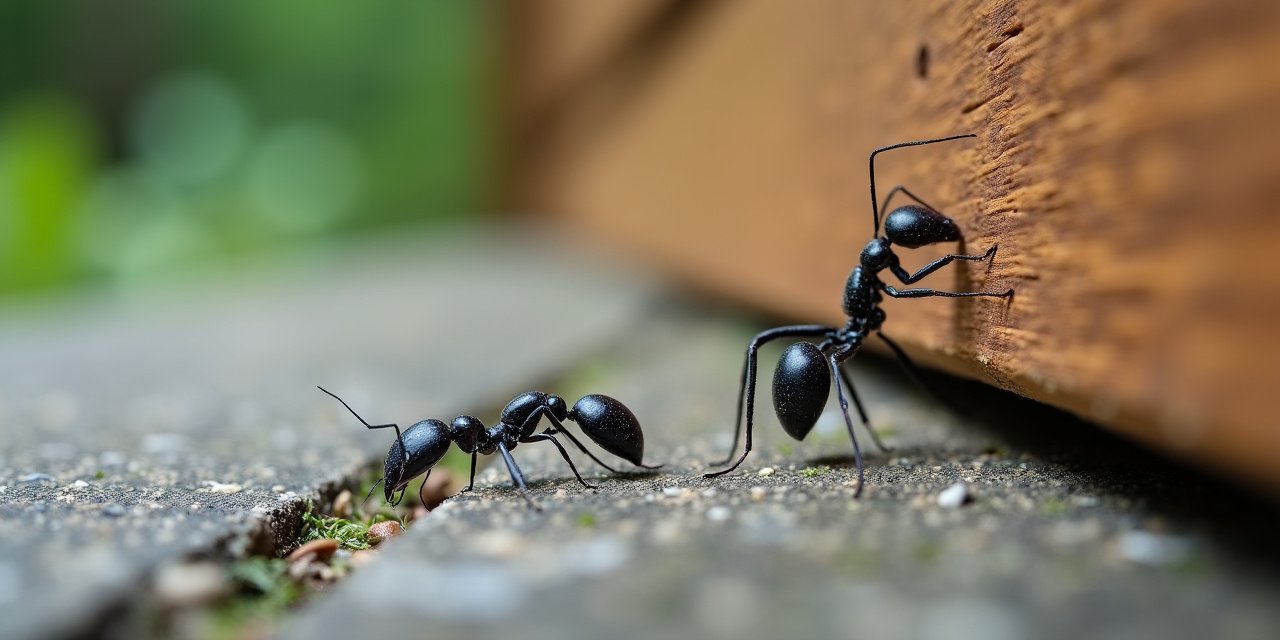
A line of ants crossing the driveway and a few ants near a windowsill can look almost identical at a glance. In most Westchester homes, they are not the same problem. Pavement ants nest under concrete and slabs. Carpenter ants nest in wood, sometimes inside your walls. The product that handles one does almost nothing for the other.
Telling them apart takes about thirty seconds once you know what to look for. Size gets you most of the way there. Location closes the gap.
Size and Color at a Glance
Size is the single most reliable clue, and you don't need a magnifying glass to use it.
Pavement ants are small, dark brown to black, and run about 1/8 inch long. Look closely and you may spot fine parallel grooves running across the head and thorax.
Carpenter ants are much bigger, 1/4 to 3/4 inch long. Most in this region are solid black. Some are bicolored, with a reddish thorax and a black abdomen, though that pattern is less common here than in warmer climates.
Pavement Ant
- Parallel grooves on head and thorax
- Even, uniform body size
- Found in large trailing lines
Carpenter Ant
- Smooth, evenly rounded thorax
- Noticeably larger than most house ants
- Often seen singly at night
Where You Found Them Matters More Than What They Look Like
Location often tells you more than appearance does. Where you spotted the ant narrows the species fast, sometimes faster than the size test.
Ants coming from a crack in the driveway, a foundation slab, or a sidewalk joint are almost always pavement ants. They nest underground and forage indoors for crumbs and grease.
Ants coming from a wall void, a damp window sill, or a piece of soft wood point to carpenter ants. A carpenter ant seen on a countertop usually traces back outdoors. The trail leads to a parent colony in a stump, dead tree, or woodpile nearby.
Quick ID Quiz
Answer two questions about the ant you found. Get a species guess and the matching treatment guide.
1. How big is the ant?
2. Where did you see it?
Ant Identification · Scarsdale & Westchester
Not sure which ant you're looking at? Guessing wrong wastes weeks of treatment.
Pristine Pest connects Westchester homeowners with licensed providers who confirm the species before they treat anything. Call to schedule an inspection.
Call (877) 938-6799Why Misidentifying Them Wastes Money
Guessing the species before treating almost always costs more in the end.
Pavement ant bait and perimeter spray do very little against a carpenter ant colony living inside a wall. Workers won't carry a driveway-formulated bait back to a nest in wood.
Carpenter ant void treatment is overkill for a pavement ant problem, and it does nothing for the colony living under the slab outside. Treating the wrong target just buys time for the real colony to keep growing.
For more on the products themselves, see our guide to ant colony treatment methods. If the ants keep returning, why ants keep coming back covers entry points and moisture issues behind repeat problems.
Frequently Asked Questions
What's the fastest way to tell a pavement ant from a carpenter ant?
Size is the fastest tell. Carpenter ants are big, often 1/4 to 3/4 inch long. Pavement ants are small, about 1/8 inch, and easy to mistake for a crumb on the floor.
Can pavement ants and carpenter ants be treated the same way?
No. Pavement ants respond well to granular bait and perimeter treatment near driveways and slabs. Carpenter ants need void treatment and finding the outdoor parent colony. Using one product on both wastes time and money.
What should I do if I see both pavement ants and carpenter ants at once?
Treat them as two separate problems, not one. Write down where each type was seen, since location tells you more than appearance. A professional inspection can confirm both species and treat each one correctly.
When should I get a professional ant identification instead of guessing?
Get a professional look if you see large ants near wood, especially with sawdust-like debris nearby. Also call if bait or spray hasn't worked after a few weeks. Misidentifying the species is the most common reason DIY ant treatment fails.