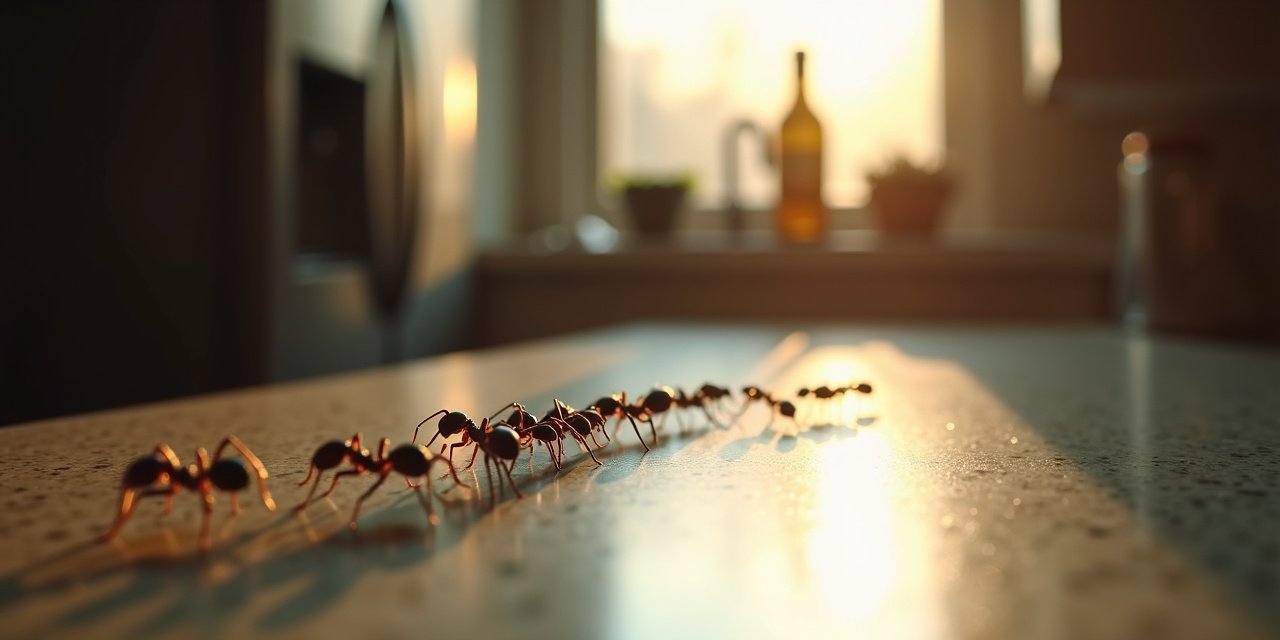
You sprayed last spring. Maybe you used a consumer spray from the hardware store, maybe you had someone come out. The ants disappeared for a few weeks. Then they were back. Same spots, same trails, same time of year. You're not doing anything wrong. This is the most common ant complaint in Westchester, and it usually has the same explanation: the treatment hit the workers, not the colony.
Understanding why ants keep returning means understanding a little about how ant colonies actually work. Once you see it, the recurring pattern makes complete sense. Fixing it permanently requires a different approach than what most homeowners try first.
The Ant Colony Is Still Outside
The ants you see in your kitchen are not the colony. They're workers: foragers sent out from a colony that almost certainly lives outdoors, usually in soil, under pavement, in rotting wood, or in the root zone of a tree or stump. A mature pavement ant colony can contain 3,000 to 5,000 workers. A carpenter ant colony can field several thousand. The workers you're swatting represent a small fraction of that population.
Here's how the system works against you. Scout ants leave the colony to find food. When a scout finds a food source inside your house, she lays a pheromone trail on her way back. Other workers follow that trail, reinforce it with their own pheromones, and a visible ant line forms within hours. Kill those visible workers and the trail doesn't go away. It lingers in the environment. New scouts from the same colony follow it. New workers get recruited. The cycle restarts.
The queen (the actual engine of the colony) is sitting safely underground or inside a protected void, laying eggs continuously. She's insulated from anything you spray at the surface. She doesn't forage. She doesn't come near entry points. As long as she's alive and producing workers, your ant problem continues regardless of how many foragers you kill.
Pheromone trails can persist on surfaces for days to weeks, even after the workers following them are gone. This is why even a successful surface treatment often produces a rebound: the trail is still there, and new scouts from the same colony find it.
Pavement Ants vs. Carpenter Ants: Two Different Problems
Not all recurring ant problems are the same, and the two most common species in Westchester homes require distinctly different treatment approaches. Grouping them together is one reason so many homeowners end up retreating the same problem every year.
Pavement ants are small (roughly 1/8 inch) and dark brown to black. They nest under driveways, sidewalks, and foundation slabs, and they enter through cracks in concrete, expansion joints, gaps around utility penetrations, and small openings in the foundation. They're primarily after food. A pavement ant problem is almost always triggered by accessible food sources: crumbs, sugar, grease residue, pet food. Remove the food, seal the entry points, and treat the exterior perimeter in spring, and you can generally manage pavement ants without recurring infestations.
Carpenter ants are a different animal entirely. They're large (workers range from 1/4 to 3/4 inch) and typically black or bicolored black and red. They don't nest under pavement. They nest in wood, and they prefer wood that's already been softened by moisture: a rotting stump 20 feet from your house, a section of water-damaged siding, a wet basement rim joist. The colony outside is the parent colony. When a parent colony grows large enough, it establishes satellite colonies: smaller nesting sites inside wall voids, window frames, or structural wood inside your home. A carpenter ant problem with an interior satellite colony requires a completely different treatment than a pavement ant problem, and consumer products almost never solve it.
What Consumer Sprays Actually Do
Consumer ant sprays (the aerosol or liquid products sold at hardware stores) are contact killers. They kill ants you spray directly, sometimes very effectively. The problem is what they don't do, and what they can actively make worse.
Most consumer sprays use pyrethroids (permethrin, bifenthrin, cypermethrin) which are repellent to ants as well as toxic. When you spray a trail, the ants not directly hit by the spray detect the repellent and retreat. This sounds like a win. But the colony response to a repellent barrier isn't always to give up. Sometimes it's to find a new route. You've disrupted one trail and potentially activated scouting behavior for new ones.
Worse, repellent sprays applied to an ant problem with multiple nest sites can cause budding: the colony, sensing threat, splits into multiple smaller colonies that each establish in a new location. You start with one problem and end up with three. This is particularly well-documented with fire ants, but it occurs with other species including pavement ants. Carpet-bombing your kitchen with spray can genuinely make a moderate ant problem into a more distributed, harder-to-treat one.
Bait products work on a fundamentally different principle. The bait is slow-acting and not immediately repellent, so foragers pick it up and carry it back to the colony as food. They share it through normal feeding behavior. The poison reaches the colony, including workers deep in the nest and, in high doses, the queen. This is the mechanism that actually collapses ant colonies rather than just displacing them. Consumer gel baits (look for products with borax, hydramethylnon, or indoxacarb as active ingredients) work on this principle and are often more effective than sprays for persistent problems. They require patience. Activity may increase briefly before it decreases.
Finding and Treating the Entry Points
If you watch where the ant trail leads, it will take you directly to the entry point. This is the most useful diagnostic tool you have. Ants don't appear through walls at random. They follow a consistent route from the exterior through a specific gap. Find that gap and you find your treatment target.
Common entry points in Westchester homes include: gaps around utility penetrations (pipes, conduit, wires entering through the foundation or sill plate), cracks in masonry or concrete at the foundation level, gaps at expansion joints in the driveway or walkway, spaces around door sweeps and window sills, and gaps where siding meets the foundation. Seal what you find with silicone caulk rated for exterior use. This won't stop an established infestation, but it's a meaningful part of a long-term solution.
Moisture elimination matters as much as sealing. Wet soil near the foundation, a leaky gutter depositing water against the house, firewood stacked against the siding, wood mulch piled against the foundation: all of these create the conditions carpenter ants and pavement ants prefer for nesting. Eliminate the moisture sources and you make your structure less attractive as a nesting site and foraging destination.
Vegetation touching the structure gives ants a bridge over any perimeter treatment you apply. Trim back any shrubs, tree branches, or ground cover that contacts the siding, soffit, or roof. This is particularly relevant for carpenter ants, which forage along branches and siding and often enter above the first floor.
Timing matters for exterior perimeter treatment. Applying a residual product around the foundation in early spring (before trailing has fully established) disrupts the scouting behavior before it recruits a full foraging force. Mid-April is typically the right window in Westchester.
Recurring Ant Problem · Scarsdale & Westchester
If they came back last year, they'll come back this year. Schedule a professional ant treatment before the season gets ahead of you.
Pristine Pest connects Westchester homeowners with licensed providers who treat ant colonies, not just the workers you can see. Call to schedule.
Call (877) 938-6799How Professional Ant Treatment Differs
A licensed pest control professional approaches an ant problem differently than a homeowner with a can of spray. Not because the products are necessarily more powerful, but because the strategy is different from the start.
The first step is identification. Is this pavement ants or carpenter ants? The answer determines every subsequent decision: where to look for the colony, what product to use, where to place bait, whether void injection is needed. A professional who gets the ID wrong is no better than a homeowner spraying blindly, which is why the initial inspection matters.
For pavement ants, professional treatment typically involves non-repellent bait placed directly at active trails. Non-repellent formulations are critical: the workers need to pick up the bait without sensing threat and carry it back to the colony. Exterior granular bait around the perimeter targets the outdoor colony. A residual exterior spray with a non-repellent active ingredient (fipronil or indoxacarb rather than pyrethroids) around the foundation completes the treatment.
For carpenter ants with an interior satellite colony, treatment adds a step: locating the satellite colony inside the structure and treating the void directly, either with injectable dust (typically diatomaceous earth or deltamethrin dust) or a foam application that expands to reach ants in the wall cavity. The parent colony outdoors also needs to be located and treated or the satellite colony will be reestablished from outside.
Professional treatment includes a follow-up inspection, typically two weeks after the initial visit, to assess whether colony activity has declined and whether additional bait placement or void treatment is needed. Most reputable providers offer a callback guarantee: if ants are still active within a specified period, they return at no charge. That accountability structure changes what kind of treatment gets used from the first visit.

Frequently Asked Questions
Why do ants keep coming back after treatment?
Because most consumer treatments only kill the forager workers you can see. They don't reach the queen or the colony. The queen keeps laying eggs, new workers get recruited, and they follow the same pheromone trails back into your home. For treatment to stick, it needs to either reach the queen (through bait carried back by workers) or eliminate the outdoor colony. A one-time spray on visible ants addresses about 5–10% of the actual colony.
How long does ant treatment take to work?
Bait-based treatments typically take 1–3 weeks to fully work because the poison needs to be carried back to the colony and shared through food exchange between ants. You may see increased activity in the first few days after bait is placed. That's normal. Do not spray the bait or the trails during this period. Contact sprays work immediately on ants they touch but do nothing for the colony. Professional perimeter treatments with residual products typically show significant reduction within a week.
Are carpenter ants dangerous to my home?
Yes. They don't eat wood, but they excavate it. A mature carpenter ant colony with satellite nests inside your walls can remove significant wood volume over several years. They prefer wood already softened by moisture, so damage often progresses in areas you can't easily inspect: rim joists, window sills, door frames around leaky areas. Structural damage from carpenter ants is real and can be costly if ignored for multiple seasons.
Can I use store ant killer instead of calling a pro?
Store products can work for minor pavement ant problems, particularly gel baits and granular baits that workers carry back to the colony. The key is using bait, not repellent spray. Spray kills foragers on contact but repels the colony, potentially causing it to split and making the problem worse. For carpenter ants, persistent infestations, or any problem that's recurred for more than one season, consumer products typically aren't sufficient.
When should I call a professional for ants?
Call a professional if you're seeing large black ants (possible carpenter ants), you've treated the same problem multiple years in a row, you find ants trailing inside walls or see swarmers indoors, you hear faint rustling when tapping wall sections, or you find frass (sawdust-like material) near wood. Also call if DIY bait placement hasn't reduced activity within 3 weeks, or if you can't identify the entry point or species.