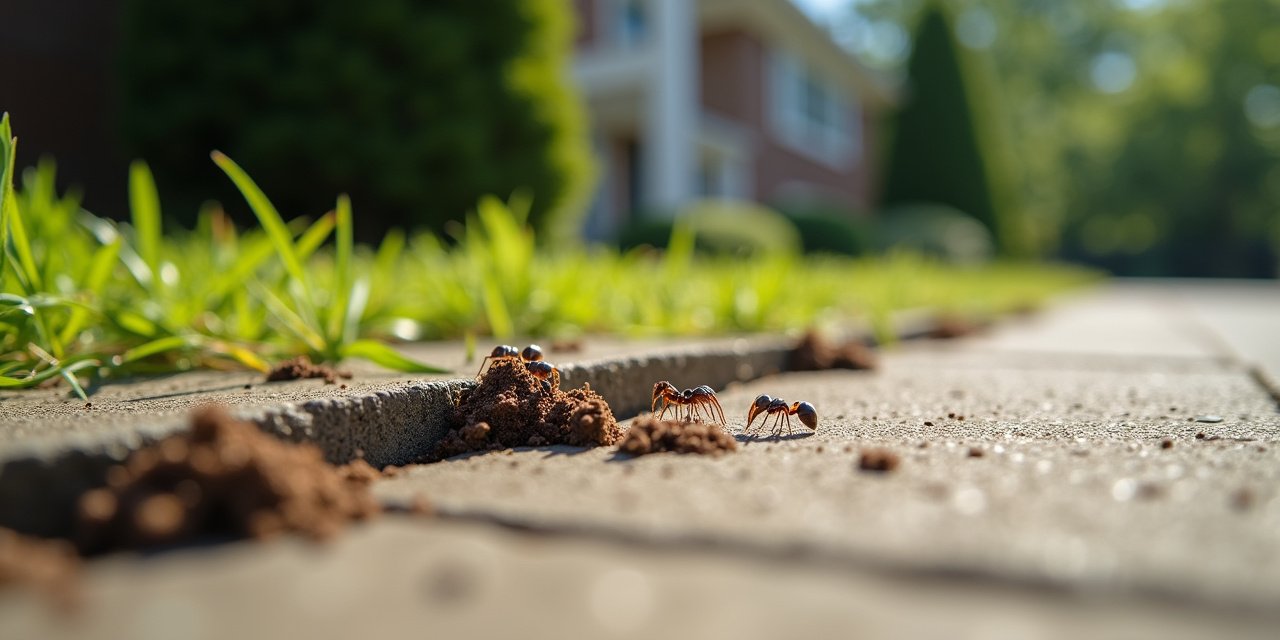
If you've watched lines of small dark ants marching across your kitchen floor each spring, you've almost certainly met pavement ants. They're one of the most persistent household pests in Westchester County — and one of the most mismanaged. Most homeowners reach for a can of spray, knock back the visible trail, and assume the problem is solved. Two weeks later, the ants are back, often in larger numbers. Understanding why this happens is the first step toward actually eliminating them.
What Are Pavement Ants?
Tetramorium caespitum, the pavement ant, is a small (1/8 inch), dark brown to black ant with parallel ridges on the head and thorax visible under magnification. Originally introduced from Europe, they are now ubiquitous across the northeastern United States.
They earn their name from their preferred nesting habitat: the soil beneath pavement, sidewalk slabs, driveways, and concrete foundations. In Westchester's older communities — Scarsdale, Eastchester, Hartsdale, Bronxville — the abundance of mature concrete infrastructure gives pavement ants near-unlimited nesting real estate directly adjacent to homes.
Their active season in Westchester runs April through June for the primary invasion, with activity continuing at lower levels through summer. Colonies can number in the tens of thousands of workers. A single queen can live for years, which means a colony that is not killed at the source will continue producing new workers indefinitely.
Why Pavement Ants Invade Homes
Pavement ants are omnivores with a preference for sweets and proteins. Scout ants leave the colony in search of food, and when one finds a source, it lays a pheromone trail back to the nest. Within hours, that single find becomes a visible highway of hundreds of workers.
Common indoor targets include crumbs under appliances, pet food bowls, fruit on counters, unsealed pantry goods, and grease residue behind stoves. The trail from the colony to the food source typically enters through:
- Foundation cracks and mortar joints in concrete block
- Weep holes in brick veneer (a standard feature in many Westchester colonial-style homes)
- Gaps around utility penetrations at the foundation
- Expansion joints between concrete slab sections
- Gaps where the siding meets the foundation
The pheromone trail persists even after the food source is removed, which is why you will often see ants patrolling a path where food used to be.
Pavement Ant Swarms: Not Termites
Each spring — and sometimes in late winter inside heated structures — pavement ant colonies produce reproductive alates: winged males and females that swarm to mate and establish new colonies. Indoor swarms emerging through slab cracks or basement floors in February and March are a classic presentation in Westchester homes with colonies nesting beneath heated concrete.
These swarms are routinely mistaken for termite swarms, causing unnecessary alarm. The identification is straightforward:
- Ants: Pinched waist (three distinct body segments), bent (elbowed) antennae, two pairs of wings of unequal length (front wings longer than rear).
- Termites: Broad waist (no pinch between thorax and abdomen), straight beaded antennae, two pairs of wings of equal length.
If you are uncertain, place a few specimens in a sealed bag and have a licensed pest control professional identify them before investing in treatment. Misidentification leads to misapplied treatment and wasted money.
Why DIY Sprays Fail — and Sometimes Make Things Worse
The most important fact about pavement ant control: repellent insecticide sprays are counterproductive. When workers encounter a repellent chemical barrier, the colony's response is to split — a behavior called budding — where a queen and a portion of the workers relocate to a new site, effectively multiplying the number of active nests. The homeowner kills a few hundred visible workers, triggers a colony split, and ends up with two or three active colonies where there was one.
This is why the same homeowner calls back two weeks later saying the ants came back in a different place. They didn't come back — they were budded off from the original colony, which is now under a different part of the foundation.
The correct approach uses slow-acting bait. Workers pick up bait material, carry it back to the nest, and share it through trophallaxis (food sharing) with nestmates and the queen. The active ingredient works slowly enough that the workers have time to distribute it widely before dying. Within 7–14 days, the queen — the only ant that can produce new workers — has been eliminated.
Professional Treatment Protocol
A licensed pest control provider treating a pavement ant infestation in a Westchester home will typically follow this protocol:
- Inspection: Identify active trails, entry points, and probable nest locations. Note the presence of satellite colonies inside the structure versus the primary colony outside.
- Gel bait application: Small applications of protein- or sweet-based gel bait are placed directly on active foraging trails inside the structure and at entry points. The bait is placed in spots where it will be found quickly but cannot be contacted by children or pets.
- Granular perimeter bait: Granular bait is broadcast along the exterior perimeter treatment zone — along the foundation, in pavement cracks and expansion joints, and in lawn areas near the nest mounds.
- Crack-and-crevice treatment: A residual insecticide is applied precisely into crack-and-crevice treatment sites at confirmed entry points — not as a broad repellent spray, but as a targeted barrier at specific gaps.
- Follow-up visits: Because baiting works through the colony over 7–14 days, one or two follow-up inspections are standard to verify colony elimination and re-bait if needed.
A satellite colony found inside the structure — a subgroup of workers and sometimes a queen that have established a nest within wall voids or beneath flooring — may require additional treatment beyond the exterior protocol.
DIY vs. Professional Treatment: Side-by-Side Comparison
| DIY Spray | DIY Bait | Professional Treatment | |
|---|---|---|---|
| Eliminates queen | ✗ No | Sometimes | ✓ Yes |
| Causes colony split | ✗ Often | ✓ Rarely | ✓ No |
| Re-treatment needed | ✗ Usually | Sometimes | ✓ Rarely |
| Works in walls | ✗ No | Sometimes | ✓ Yes |
| Typical timeline | Days | 2–4 weeks | 7–14 days |
| Cost (single treatment) | $15–$40 | $20–$50 | $150–$300 |
Treatment Timeline: What to Expect
After professional baiting, ant activity often increases for the first 2–3 days. This is normal and expected — workers are actively picking up bait and the colony is responding to the food source. Resist the urge to spray or wipe away the bait. Disrupting the bait trail resets the process.
By days 5–7, visible trail activity should begin to decrease noticeably. By days 10–14, most properly treated infestations show a dramatic reduction in ant activity — often complete elimination of visible trails. A follow-up visit at 2 weeks allows the provider to confirm success and apply additional bait if any secondary trails persist.
Pavement Ants Coming Back Every Spring?
Pristine Pest connects Scarsdale and Westchester homeowners with licensed ant control professionals who use targeted baiting — not repellent sprays — for lasting results.
Call (877) 938-6799Lead generation service. Licensed providers in your area will contact you. Disclaimer.
Prevention: Keeping Pavement Ants Out Long-Term
After treatment, maintaining results requires addressing the conditions that made your home attractive in the first place:
- Seal foundation cracks: Use concrete patching compound on block or poured foundations, and silicone caulk on smaller gaps. This is the single most effective prevention measure.
- Remove pavement mounds: The characteristic sand/soil mounds that pavement ants push up through sidewalk cracks signal an active nest directly below. Brushing them away does not eliminate the nest — professional treatment or boiling water applied directly is needed.
- Eliminate food sources: Keep kitchen surfaces clean, store dry goods in sealed containers, and remove pet food bowls between meals.
- Trim vegetation at the foundation: Dense plantings against the foundation provide moisture and cover that attracts ants. Maintain a 12-inch clear zone between plantings and the foundation.
For related reading, see our post on why ants keep coming back and how to tell the difference between carpenter ants and termites. For a complete range of ant control services in Westchester, visit our Ant Control service page.
Frequently Asked Questions
What are pavement ants?
Pavement ants (Tetramorium caespitum) are small black or dark-brown ants, approximately 1/8 inch long, named for their habit of nesting under pavement, sidewalks, and driveways. They are one of the most common ant species in Westchester County and are typically most active from April through June.
Are pavement ants dangerous?
Pavement ants are not dangerous to people — they rarely bite and do not carry diseases. However, they are a significant nuisance pest when they enter homes, contaminating food and nesting in wall voids and beneath flooring. Large colonies inside a structure can be difficult to eliminate without professional treatment.
Why are pavement ants swarming in my house in winter?
Indoor pavement ant swarms in winter or early spring are caused by colonies nesting beneath heated concrete slabs — a common situation in Westchester homes with slab foundations or heated garages. Warmth from indoor heating triggers the colony's reproductive swarm. Winged pavement ant alates are often mistaken for termite swarmers; key differences are the pinched waist, bent antennae, and unequal wing length of ants.
How do I get rid of pavement ants permanently?
Permanent elimination requires killing the queen. This is achieved through slow-acting bait that worker ants carry back to the colony. Professional treatment using gel bait along foraging trails, granular bait on the exterior perimeter, and crack-and-crevice treatment at foundation entry points is the most reliable approach. Repellent sprays should be avoided — they scatter colonies and make the problem harder to solve.
How much does professional pavement ant treatment cost in Westchester?
A single professional pavement ant treatment in Westchester County typically costs $150–$300 depending on property size and severity of infestation. Most providers recommend 1–2 follow-up visits included in an initial treatment program. Season-long ant prevention programs are also available and often provide better long-term value.