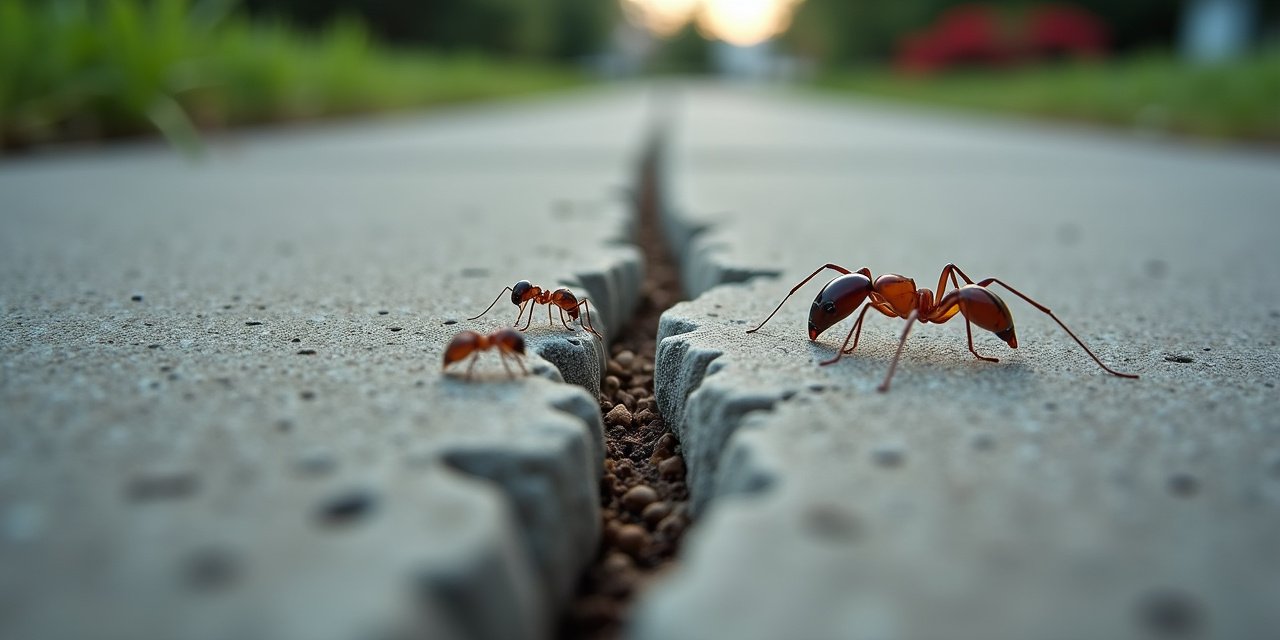
You've probably swept them away a dozen times. The little sandy mounds that appear in your driveway expansion joints or along the walkway edge every spring. You brush them off, maybe spray something around the edges, and by mid-summer they're back, usually in the same spots, sometimes in new ones too.
That's pavement ant behavior in a nutshell. The colony is living under your concrete, the foragers come up through whatever gap is available, and any treatment that doesn't address what's happening below the slab is just a temporary fix.
Where Pavement Ants Actually Live
Pavement ants get their name honestly. They build colonies in the soil directly beneath concrete slabs, driveways, patios, and sidewalks. The concrete above acts as insulation and protection. It keeps the nest stable and hidden. Workers excavate small chambers and tunnels in the soil underneath and push the debris upward through any available gap.
Those sandy mounds in your cracks aren't dirt from the surface. They're excavated material from below. The colony is telling you exactly where it is.
From those nests, foragers travel along foundation edges, through expansion joints, under doors, and through any gap in your foundation to find food indoors. They can travel 30 feet or more from the nest on a foraging run. This is why you might see a trail running across your kitchen floor that seems to start from nowhere. The actual entry point is probably at the base of your foundation, not through a gap you can see inside.
Common Pavement Ant Entry Points Around Your Home
Driveway expansion jointsThe gap between driveway sections is a direct path to under-slab nesting sites.
Foundation cracks & gapsAny crack at the base of the foundation wall is a potential entry point for forager trails.
Utility penetrationsPipes and conduit entering through the slab or foundation leave gaps that rarely get sealed completely.
Soil grade against foundationSoil or mulch graded against the foundation wall gives ants direct access at ground level.
Walkway-to-foundation gapThe small gap where a concrete walkway meets the foundation is a common colony entry zone.
Stacked firewood near foundationFirewood stored close to the house traps moisture and creates a harborage that connects directly to the foundation zone.
Why Spray Alone Won't Hold Through Summer
Consumer contact sprays kill foragers on contact. That's not nothing. You'll see a reduction in visible trail activity within a day or two. But here's the problem: the colony doesn't know anything happened. The queen keeps laying. New foragers get recruited. Within a week or two, the trail reconstitutes. You've just selected for slightly more cautious foragers.
Even professional-grade residual perimeter sprays have the same limitation if applied alone. They knock back forager populations and create a barrier, but a healthy colony under your slab will push through that barrier as the season progresses, especially as soil temperatures rise and foraging activity intensifies.
Treatment that holds through summer needs to reach the colony. That means bait.
Granular Bait: How to Use It Correctly
Granular bait applied directly to active trails is the most effective tool for pavement ant colonies. Workers pick up the granules, carry them back underground, and share them with nestmates including the queen. When it works, you see colony collapse within 2–4 weeks rather than just a surface-level reduction in visible ants.
A few things matter for bait to work. First, place it where the ants already are: on the trail or directly next to the expansion joint where you see activity. Don't scatter it randomly around the yard. Second, don't spray over it or disturb the trail while bait is active. Third, understand that you'll often see increased activity for the first several days as more foragers come to collect the bait. That's a good sign, not a failure.
Timing also matters. Early spring treatment (April and May in Westchester) catches colonies before they reach peak summer populations. A smaller colony needs less bait to collapse and is easier to eliminate before the season's heaviest foraging period. For more detail on the overall treatment process, see our guide to professional ant colony treatment methods.
Pavement ants back every year in the same spots?
Get connected with a licensed Westchester provider who can treat the colony, not just the trail.
Call (877) 938-6799What Professional Treatment Adds
A licensed technician brings a few things a homeowner typically can't match. The first is product access: professional-grade granular baits and non-repellent residuals are more potent and longer-lasting than what's on home improvement store shelves. The second is application accuracy. Knowing exactly where to place bait for maximum uptake, how much to apply, and when to reapply takes field experience with this specific species.
Professionals also treat the perimeter as a system rather than spot-treating individual trails. That means covering all likely entry points shown in the diagram above: the expansion joints, the utility penetrations, the foundation edge where the soil meets concrete. A thorough perimeter application combined with bait at active colony sites is what makes the difference between a treatment that holds through August and one that wears off by July.
For pavement ant-specific treatment approaches, see our pavement ant service page. And if you're not 100% sure which species you're dealing with, our ant identification guide can help you confirm before calling anyone.
After Treatment: Making It Harder to Come Back
Once treatment has collapsed the existing colony, a few maintenance steps make re-infestation less likely. Sealing visible expansion joint cracks with a flexible polyurethane caulk closes the most obvious entry routes. Moving firewood away from the foundation removes a prime harborage zone. Keeping soil graded away from the foundation (a slight downward slope away from the house) eliminates the moisture-rich soil zone that pavement ant colonies prefer.
None of these prevent all future activity. Pavement ants are everywhere in Westchester and neighboring colonies will eventually scout your property again. But they extend the effective window between treatments significantly. If you've been dealing with recurring problems, our guide to signs of a pest problem in Westchester homes is also worth a read to catch issues earlier next season.
Frequently Asked Questions
Why do pavement ants come back every year in the same spots?
Because the colony is still there. Unless treatment reaches and eliminates the queen, the colony persists through winter in a dormant state and resumes foraging activity in spring. Pavement ant colonies can live 5–10 years in the same location under a slab or alongside a foundation. Spraying visible foragers each spring addresses the symptom without touching the source.
Do the sand piles in my driveway cracks mean pavement ants?
Almost certainly, yes. Those small mounds of fine granular soil pushed up through expansion joints or cracks in concrete are a classic pavement ant sign. The colony excavates soil from beneath the slab to expand galleries and pushes the debris upward through the nearest opening. If the piles reappear after you brush them away, the colony is active.
Can I just seal my driveway cracks to stop pavement ants?
Sealing cracks reduces entry points but doesn't eliminate the colony. Ants can find or create new openings fairly quickly, especially in older concrete. Crack sealing is a good supplemental step after treatment: it makes re-entry harder and reduces the number of spots you need to monitor. By itself it won't solve an active infestation.
When is the best time to treat pavement ants in Westchester?
Early spring (April through May) is the most effective window. Colonies are active but haven't yet reached their summer peak population. Treating before peak foraging season means the bait or perimeter spray encounters a smaller worker population and has a better chance of reaching the queen before the colony has fully ramped up. Summer treatments still work but may require a second application.
Is granular bait or liquid spray better for pavement ants?
Granular bait applied directly to active trails near expansion joints and foundation edges is typically more effective for long-term control because it targets the colony. Liquid perimeter spray provides faster knockdown of foragers but doesn't reach the queen. Professionals often use both: bait for colony elimination, residual perimeter spray to reduce re-infestation from neighboring colonies.