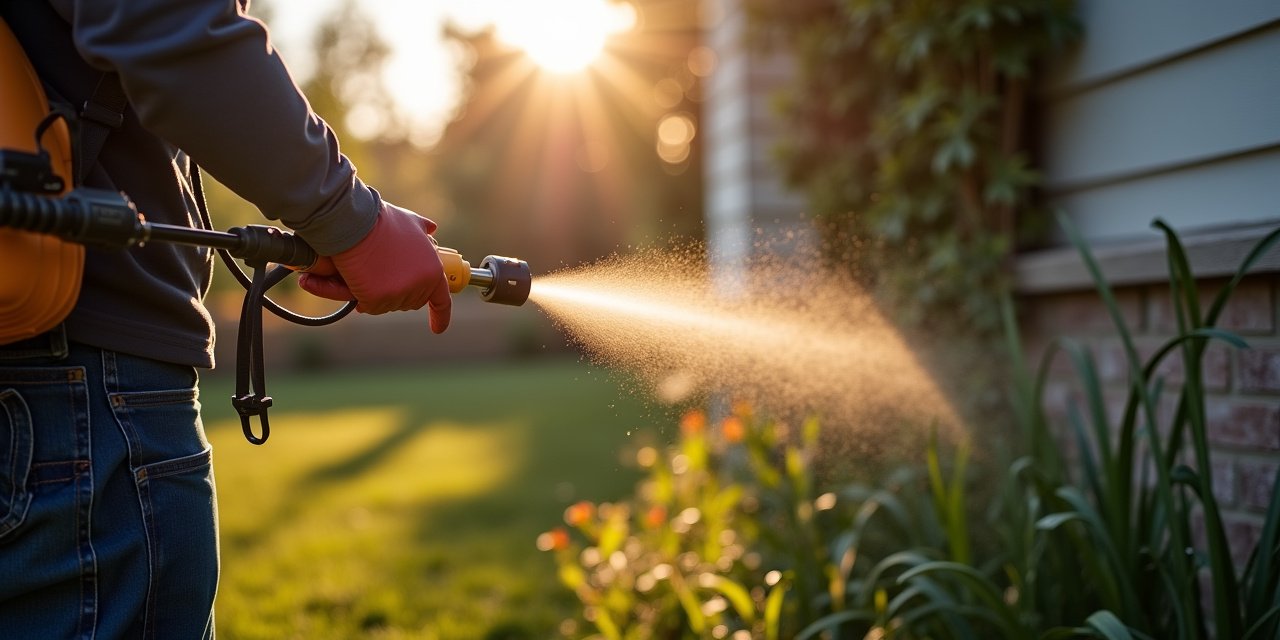
Many homeowners think more spraying means better protection. Spray twice as often, get twice the defense. That assumption misses how residual pesticides actually work.
The real variable isn't frequency. It's how long the product stays active, and when it gets applied. A residual treatment that's timed wrong fails even with frequent reapplication.
This guide breaks down what "residual" actually means, how long these products last, and why timing beats frequency every time.
What Makes a Treatment "Residual"
A residual product is formulated to stay active on a surface for an extended period. It keeps killing insects that walk across it long after the spray dries. That's different from a one-time knockdown spray, which kills on contact and then breaks down within hours.
Knockdown sprays are built for speed. They clear visible activity fast, then lose potency. A barrier spray applied around a foundation is designed to keep working for weeks, not hours.
The active ingredient, the surface it's applied to, and weather exposure all affect how long that residual window lasts.
How Long Residual Products Actually Last
Most residual products remain effective for two to twelve weeks. The exact window depends on the chemistry used and the conditions outside.
UV exposure breaks down active ingredients faster on sun-exposed surfaces than on shaded ones. Rainfall washes residue off exterior surfaces, especially within the first 24 to 48 hours after application. Product chemistry matters too: some formulations are built to bind tightly to surfaces, others degrade faster by design.
A barrier spray applied to a shaded, protected foundation in dry weather might hold for six to eight weeks. The same product on a sun-baked, rain-exposed wall could taper off in half that time.
Residual Effectiveness Over Time
A typical barrier spray loses strength gradually rather than all at once. This chart is illustrative; actual decay varies by product, surface, and weather.
Why Spraying More Often Doesn't Fix a Bad-Timing Problem
Reapplying a residual product on a fixed calendar, say every 30 days, ignores what's actually happening to the chemical on your walls. If it degraded in three weeks, you spent a week with no protection before the next visit.
Spraying more often can't undo the wrong timing choice. A treatment applied right before a heavy rain, or in peak UV exposure, breaks down faster no matter how many times you repeat it.
The fix isn't frequency. It's matching application timing to conditions and to how long that specific product actually holds up outdoors.
Illustrative Only: Estimate Your Treatment Status
Drag the slider to the number of weeks since your last perimeter spray. This is a rough illustration, not a substitute for a professional inspection.
Perimeter Spray Timing · Scarsdale & Westchester
Not sure if your last treatment is still holding, or if you're due for another?
Pristine Pest connects Westchester homeowners with licensed providers who time treatment to weather and product, not just the calendar.
Call (877) 938-6799What Professionals Do Differently
Licensed technicians don't default to a fixed spray schedule. They choose products based on the pest pressure, the surface, and the season.
Application timing gets tied to weather forecasts, not just a calendar reminder. A tech might delay a barrier spray a day to avoid rain washing it off within hours.
Professionals also rotate or layer products so a declining residual doesn't leave a full gap in coverage. That's a different approach than reapplying the same product every fixed number of weeks.
For more on how routine treatment programs are structured, see our guide on professional pest control methods. If ants are your specific concern, our breakdown of ant colony treatment methods and our colony budding guide cover related mistakes. Our exterminator page covers what a full perimeter treatment program includes.
Frequently Asked Questions
What does "residual" mean in pest control?
Residual means the product stays chemically active after it dries. It keeps killing insects that touch the treated surface for days or weeks. That's different from a spray that only kills on direct contact at the moment of application.
How long does residual treatment typically last?
Most residual products last two to twelve weeks, depending on the formulation. Sun exposure and rainfall shorten that window significantly. A product applied to a shaded, dry surface generally lasts longer than one exposed to direct weather.
Why does timing matter more than spray frequency?
Because a residual product loses potency on a schedule set by weather and chemistry, not by your calendar. Spraying more often doesn't extend a window that's already closing. Getting the timing right the first time protects longer than repeating a poorly timed application.
How do professionals decide when to re-treat?
They factor in the product's expected residual window, recent and forecasted weather, and visible pest activity. A technician might move a scheduled visit up after heavy rain washes off a recent application. That's more accurate than sticking to a fixed monthly schedule regardless of conditions.