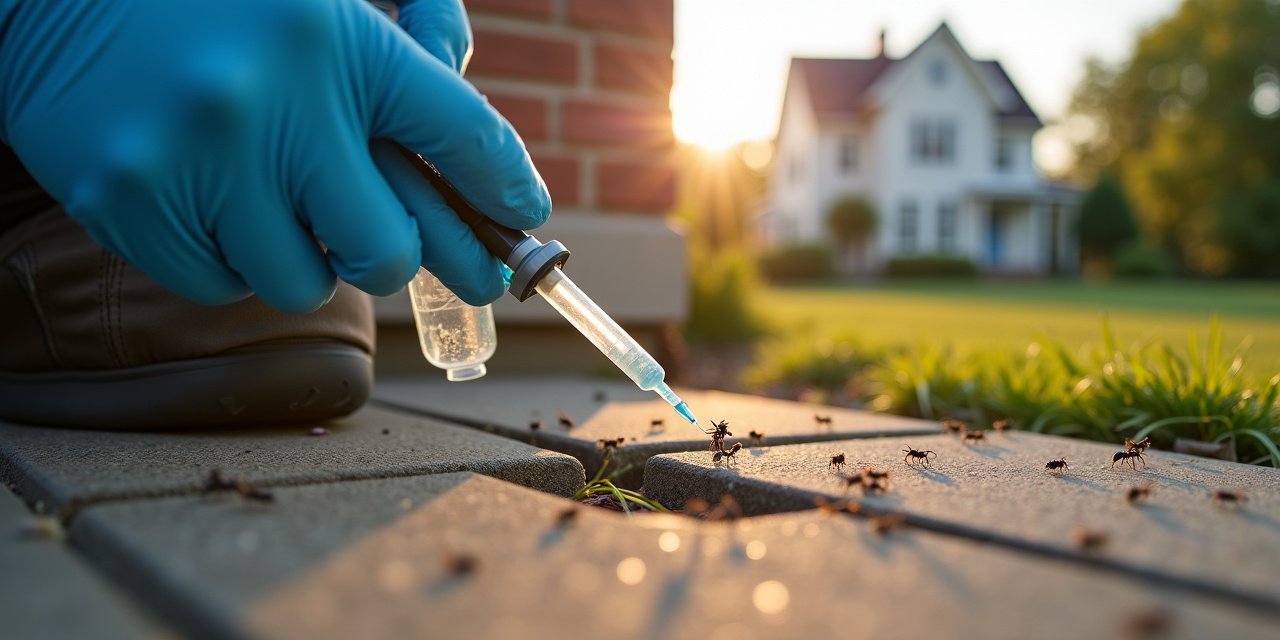
You sprayed the ants under the kitchen sink. They vanished for three days. Then they showed up in the bathroom. A week later, ants appeared near a window upstairs you'd never had trouble with before. You didn't get a new infestation. You probably split the old one.
This is colony budding. It's one of the most misunderstood outcomes in DIY ant control. A repellent spray doesn't just fail sometimes. Under the wrong conditions, it converts one contained problem into several scattered ones. Here's the mechanism, which ants are prone to it, and what actually stops it.
What Colony Budding Actually Is
Ant colonies aren't always a single queen in a single nest. Several common species, including pavement ants and odorous house ants, naturally form loosely connected networks. One parent nest, satellite pockets nearby, sometimes more than one queen. That structure exists for normal reasons: resource access and crowding.
Budding hijacks that same structure as a defense mechanism. When a colony detects a chemical threat, worker ants abandon the nest and relocate to a new site nearby. Some carry eggs and larvae with them. Some carry a queen. One colony becomes two. If the threat persists, two can become three or four, and each new site behaves as its own colony from then on.
The trigger isn't the poison itself. It's the repellency. Pyrethroid sprays (permethrin, bifenthrin, cypermethrin) repel on contact, and that repellency is what signals danger to the colony. A product can kill every ant it touches and still make the underlying problem worse.
Which Westchester Ants Actually Bud
Not every ant species responds to spray stress the same way. Two are the ones homeowners in this area run into most.
Pavement ants are the most budding-prone species locally. Their colonies are already loose, multi-queen networks under driveways and slabs. That structure primes them to fracture under stress. Spray a pavement ant trail hard enough and one driveway colony can become several.
Odorous house ants behave similarly, and are arguably more famous for it in pest control literature. Their colonies often include multiple queens with no spray involved at all. A chemical disturbance just accelerates a split that was already possible.
Carpenter ants are a different case. A mature parent colony can already establish satellite colonies indoors as normal growth, not as a stress response. That distinction matters for treatment. A carpenter ant satellite problem needs the parent colony found and treated regardless of the trigger. A budded pavement ant network needs every fragment found and treated on its own.
How the Spray-and-Spread Cycle Actually Unfolds
The pattern is consistent enough that pest professionals can usually reconstruct the treatment history just from where the ants showed up next.
Homeowners usually read step four as a treatment failure, or a brand new infestation. It's neither. It's the same colony, now spread across more square footage. That's why the second and third spray attempts tend to work even less than the first.
Try It: Spray vs. Bait
Click a treatment method. See how a single pavement ant colony typically responds over the next two weeks.
Budded Ant Colony · Scarsdale & Westchester
If ants spread to a new room after you sprayed, you likely need to treat several colonies, not one.
Pristine Pest connects Westchester homeowners with licensed providers who map every active trail before treating. Call to schedule an inspection.
Call (877) 938-6799Why Non-Repellent Bait Doesn't Trigger the Same Response
Bait works on an entirely different principle. That's exactly why it doesn't cause budding. A non-repellent formulation doesn't alarm the ants that contact it. Foragers pick it up believing it's ordinary food. They carry it back to the nest and share it colony-wide through trophallaxis, a normal feeding behavior. No repellency means no threat signal, and no reason for the colony to fracture.
This is slower by design. Trophallaxis takes time to reach every worker, every larva, and eventually the queen. Most bait programs need one to two weeks to show a full effect. Activity can briefly tick up in the first few days, as foragers recruit more workers to the newly found food. That uptick isn't failure. It's the bait being carried exactly where it needs to go.
What to Do If You've Already Triggered Budding
If ants have already spread to new areas, the fix isn't a stronger spray. Map every active trail as its own site. Treat each one with non-repellent bait instead of assuming one application reaches a now-scattered colony network.
A professional inspection typically walks the full interior and exterior perimeter first, to find every current trail, not just the one you called about. Each trail gets bait placed directly at the point of activity. Budded fragments are usually still the same original colony genetically, so treating all of them at once stops the untreated fragments from repopulating the ones you did address.
For why recurring ant problems happen in the first place, including entry sealing and moisture control, see our guide on why ants keep coming back every spring. For bait versus spray mechanics across species, see ant colony treatment methods. Our ant control page covers what a full inspection and treatment program includes.
Frequently Asked Questions
How do I know if I've triggered colony budding?
The clearest sign is new ant activity in a room that was never a problem before. It usually shows up within a few days to two weeks after a spray. A single trail splitting into two or three separate trails is another sign.
Which ants are most likely to bud when sprayed?
Pavement ants and odorous house ants are the two species Westchester homeowners most often trigger into budding. Both already form loosely connected, multi-queen networks that split easily under chemical stress.
Is it too late to fix a budded ant colony?
No, but it takes a different approach. Non-repellent bait placed at each active trail lets workers from every sub-colony carry the active ingredient back on their own.
Will non-repellent bait cause budding the way sprays do?
No. Because non-repellent bait doesn't trigger the ants' threat response, foragers keep behaving normally. There's no chemical alarm signal pushing the colony to fracture and relocate.