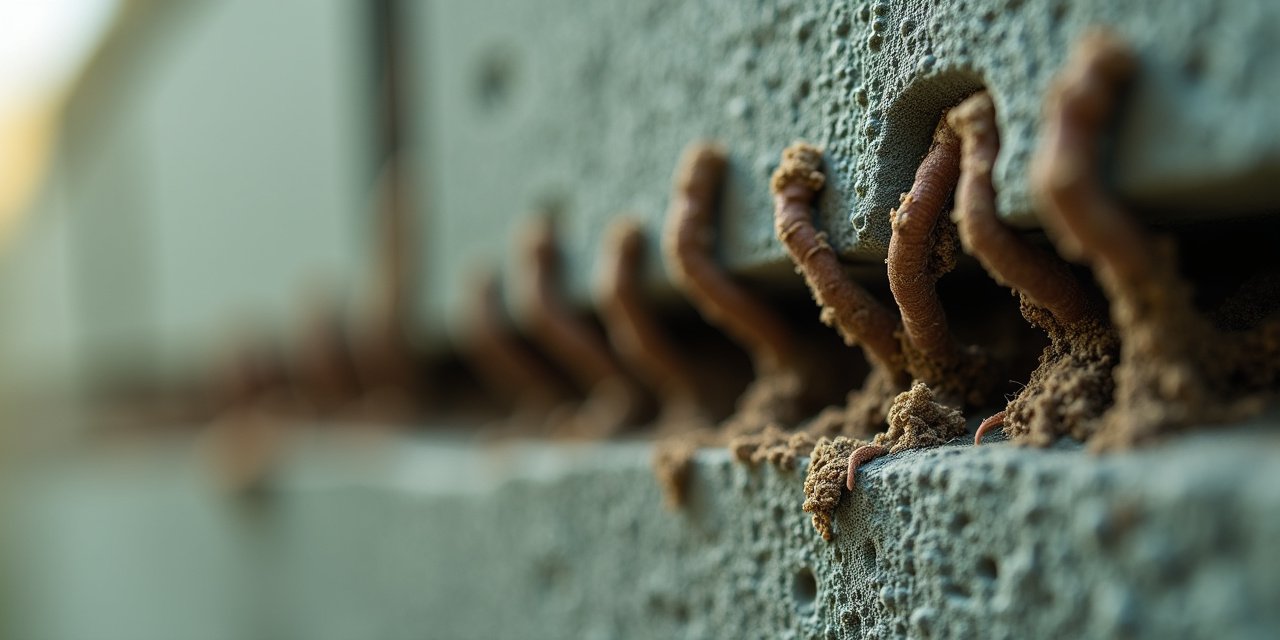
You walk the foundation and spot a thin line running up the concrete. It could be a hardened termite tube. It could just be ants walking the same path they walk every day. Both look like a line on a wall from ten feet away, but they mean two very different things for your house.
Mixing them up is common, and it's an expensive mistake in either direction. Treating a termite tube like a nuisance ant trail wastes the weeks you need to get an inspection scheduled. Treating an ant trail like a termite emergency means paying for services you don't need. Here's how to tell them apart on sight.
What Termite Mud Tubes Actually Look Like
Eastern subterranean termites build mud tubes to travel between the soil and a wood food source without drying out. The tube is roughly the width of a pencil. Some grow thicker over time, but pencil-width is the usual starting point.
The material is soil mixed with termite saliva and fecal matter, packed into a hardened tunnel. It feels gritty and stiff, closer to dried clay than dust. Run a finger along one and it won't wipe off like surface dirt. You'll feel a raised, tube-shaped ridge.
Mud tubes run vertically most of the time, climbing from soil level up a foundation wall or a support pier toward exposed wood. They're usually tan, brown, or gray, matching the local soil color. Break one open and you may find live white or cream-colored worker termites inside, though an old, abandoned tube will be hollow and dry.
What an Ant Pheromone Trail Looks Like
An ant trail isn't a structure at all. It's a faint visible line formed by the ants themselves, walking the same route over and over between a food source and the nest.
Ants navigate by following a pheromone trail laid down by earlier scouts. Each worker reinforces the scent as it passes. That's why the same crack or seam keeps getting used for days at a stretch.
There's nothing hardened left behind if the ants move on. No tunnel, no raised ridge, no material you can chip away with a fingernail. Wipe the surface clean, and if ants stop appearing within a day or two, that confirms it was a trail.
A trail can look like a thin dark smudge when ants are actively present, especially with pavement ants or odorous house ants. Without the ants themselves walking it, the trail is invisible to the eye.
Quick Check: What Am I Looking At?
Answer two questions about the line on your foundation to get a quick read.
1. Does it feel hard and raised, or flat against the surface?
2. Are live ants visibly walking on the line right now?
Foundation Evidence · Scarsdale & Westchester
Not sure if what you found is a mud tube? Get it confirmed before it spreads further.
Pristine Pest connects Westchester homeowners with licensed inspectors who can identify foundation evidence on sight. Call to schedule a look.
Call (877) 938-6799Why the Wrong Call Costs You
A termite mud tube needs immediate professional inspection. Subterranean termites can cause real structural damage the longer an active connection to your home goes unaddressed. Waiting a season to "see if it comes back" is the wrong move with a confirmed tube.
An ant trail doesn't carry that same urgency. Ants are a nuisance, and carpenter ants can damage wood over time. A single foraging trail on a foundation wall is not a structural emergency, and it can usually wait for a scheduled treatment.
The risk runs both directions. Homeowners who assume every foundation line is "probably just ants" sometimes ignore an active mud tube for months. Homeowners who panic at every ant trail sometimes pay for termite treatment they never needed. Confirming which one you have before acting protects both your house and your budget.
For a deeper breakdown of body shape, wings, and damage patterns, see our guide on carpenter ants vs. termites. If you've already found damaged wood, our guide on warning signs of termite damage covers what to look for next. Our termite protection page covers inspection and treatment options if a tube is confirmed.
Frequently Asked Questions
What is the physical difference between a mud tube and an ant trail?
A mud tube is a hardened, pencil-width tunnel built from soil and saliva. It stays on the wall whether or not anything is moving through it. An ant trail is just a scent path, a faint line of ants walking a repeated route, with no physical structure left behind.
Which one requires urgent action, a mud tube or an ant trail?
A mud tube requires urgent action. It means subterranean termites are actively moving between the soil and your home. An ant trail does not carry the same urgency and usually waits for a normal scheduled treatment.
Can a mud tube and an ant trail be on the same foundation wall at once?
Yes. Termites and ants are unrelated insects, so one doesn't rule out the other. Treat each piece of evidence on its own, and don't assume one explains the other.
How do I check a mud tube without disturbing the evidence?
Photograph it from a few angles first. If you want to confirm activity, break a small section open with a stick, not your finger, and check for termites inside. Leave the rest of the tube intact for a licensed inspector.