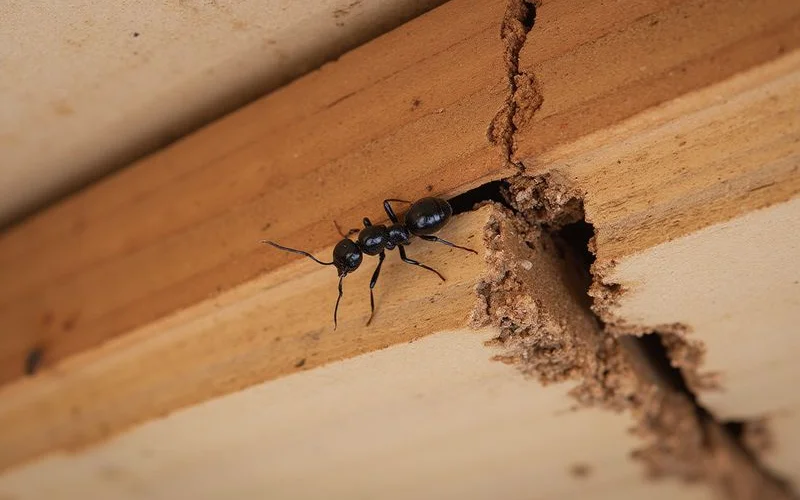
Understanding Carpenter Ants
Carpenter ants are among the most destructive ant species in the Northeast. Unlike termites, carpenter ants do not eat wood—they excavate it to create nests.
Over time, this excavation can compromise structural integrity.
Scarsdale's mature landscapes with abundant trees provide ideal conditions for carpenter ant colonies. The parent colony typically establishes outdoors in moist, decaying wood, then sends swarmers (reproductive ants) to establish satellite colonies inside homes.
Signs of Carpenter Ant Activity
- Frass: Fine, powdery debris (wood shavings) near wooden structures
- Live ants: Large black ants, especially in spring and summer
- Swarmers: Winged ants emerging from walls or ceilings in spring
- Hollow sounds: Wood that sounds hollow when tapped
- Rustling sounds: Activity audible in walls at night
Why Professional Treatment Is Essential
DIY treatments rarely succeed because they only kill visible workers—the queen remains protected in the nest, continuing to produce more ants. Our partner professionals:
- Locate the parent colony (often outdoors)
- Identify all satellite colonies
- Use baits that workers carry back to the nest
- Apply residual sprays for ongoing protection
- Recommend exclusion repairs
The Colony Elimination Process
Inspection and Identification
Technicians identify foraging patterns, locate nest sites, and determine whether you're dealing with a single colony or multiple interconnected colonies.
Bait Application
Bait stations are placed along ant trails. Workers consume bait and share it through trophalaxis (food sharing), eventually poisoning the queen and eliminating the colony.
Direct Nest Treatment
When satellite colonies are located, technicians may apply dust insecticides directly into wall voids or wood galleries.
Exclusion and Prevention
Exclusion is critical for long-term control:
- Seal cracks in foundations
- Replace moisture-damaged wood
- Trim tree branches away from the house
- Move firewood away from the structure
- Install weep vent screens
Damage Assessment
Our partners can assess existing damage and recommend repairs. Severe infestations may require consultation with a structural engineer or contractor.
Frequently Asked Questions
How much damage can carpenter ants cause?
While slower than termites, carpenter ants can cause significant structural damage over several years. Large, established colonies can excavate significant amounts of wood.
Do I need to replace damaged wood?
Not necessarily. Minor damage can be repaired with wood filler.
Severe damage to structural members may require replacement by a contractor.
When are ants most active?
Carpenter ants are most active in spring through fall. Swarmers (winged reproductives) typically emerge in spring on warm days.
Can I prevent carpenter ants?
Yes. Reduce moisture problems, seal entry points, keep vegetation trimmed away from your home, and store firewood away from the structure.
Act Now Before Damage Worsens
Carpenter ant infestations do not resolve on their own—they worsen over time. Contact our network of licensed professionals for comprehensive inspection and treatment.
Related Resources
Learn about carpenter ant biology in our glossary. For more information, visit Cornell Entomology.